Electrical documentation for Houston industrial projects.
For oil, gas and process work, start with the design basis, equipment information and current distribution drawings. Agree the hazardous-area inputs, vendor interfaces and issue responsibilities with your engineering team.
Gulf Coast engineering runs on drafting capacity you can't hire fast enough.
Houston is the operational centre for the world's largest concentration of oil & gas, petrochemical, and LNG engineering. Gulf Coast refineries, Permian infrastructure, LNG export terminals, Houston petrochemical corridor — every project runs on tens of thousands of sheets of electrical documentation that have to be produced, revised, and re-issued without a single hazardous-area classification error.
The bottleneck isn't engineering talent. Houston has that in depth. The bottleneck is specialist production drafting capacity when projects surge, and the rework cost when inexperienced vendors miss NEC Article 500 classifications or mis-route heat tracing.
We built Advanced Mechanix for exactly that problem. Our production team works to NEC 2023, API RP 500/505 hazardous-area classifications, and IEEE 515 heat-tracing standards, inside AutoCAD Electrical, Microstation, or client-hosted SmartPlant environments.
- CST timezone overlap for overnight-turnaround workflows
- NEC Art. 500 / 505 hazardous-area classification expertise
- Gulf Coast EPC subcontractor workflows supported
- Scope and review requirements agreed before production
Documentation types we produce for Houston projects

Hazardous-Area Classification
NEC Article 500 and 505 classification drawings, API RP 500/505 petrochemical referencing, equipment schedules, and installation detail for Class I Div 1/2 and Zone 0/1/2 environments.

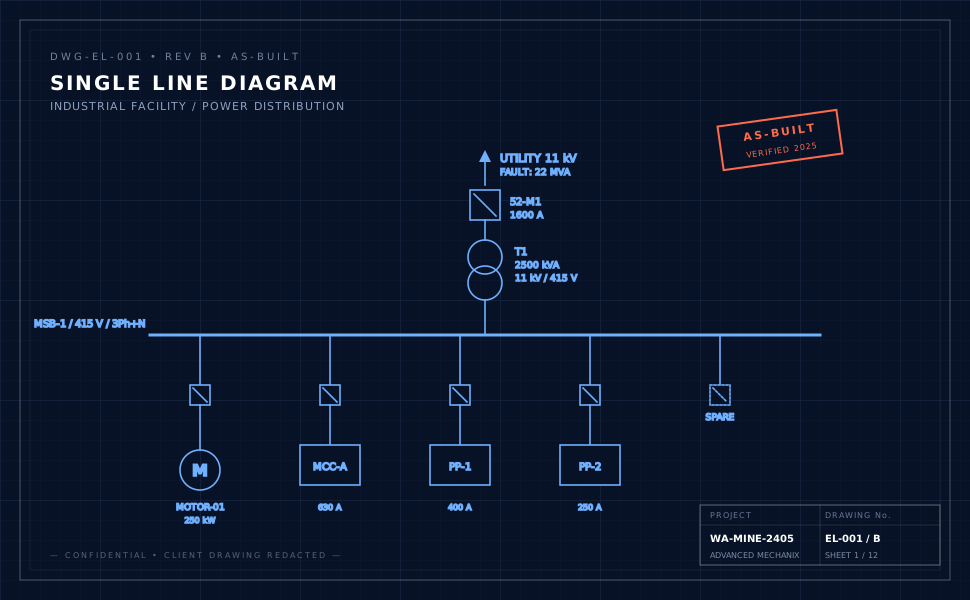
Single-Line Diagrams & SLDs
Complete SLDs for Gulf Coast process facilities: utility sources, substations, MCCs, VFDs, and process loads at 13.8 kV / 4.16 kV / 480 V.

Heat Tracing (IEEE 515)
Heat tracing layouts, circuit schedules, and temperature maintenance design per IEEE 515 for pipeline freeze protection and process heating in Gulf Coast facilities.

Cable & Raceway Schedules
Comprehensive cable schedules, tray routing, conduit schedules, and segregation plans for process facilities with multi-discipline coordination.

Arc Flash & Protection Studies
IEEE 1584-compliant arc flash analysis and NFPA 70E labeling for Gulf Coast industrial facilities. Protection coordination and short-circuit studies in ETAP or SKM.
Substation & Switchgear
13.8 kV and 4.16 kV substation and switchgear documentation including protection schemes, relay schedules, and control schematics.
The codes we verify every drawing against.
| Standard | Scope |
|---|---|
| NEC 2023 (NFPA 70) | Foundational US electrical code |
| NEC Art. 500 | Hazardous (classified) locations — division system |
| NEC Art. 505 | Hazardous locations — zone system (IEC-aligned) |
| API RP 500 / 505 | Recommended practice for classification of petroleum facilities |
| IEEE 515 | Electrical heat tracing design |
| NFPA 70E / IEEE 1584 | Arc flash safety & incident energy calculation |
| ISA 12.x series | Instrumentation in hazardous locations |
Start with a defined scope.
Agree the source information, deliverables and review requirements before the first issue.
Your team. Our team.
A clear way to work.
Agree the standards, review responsibilities and working arrangements before the first issue.
Quality: who checks the drawings?
The checking brief covers the project standard, drawing references and review responsibilities. We agree the internal checks, client review sequence, revision allowance and response windows as part of the package scope.
Standards: will you draw to our codes and templates?
We work to the standard that applies to your project: NEC (US), IEC 60364 and IEC 61439, AS/NZS 3000 (Australia and New Zealand), CSA C22.1 (Canada) and BS 7671 (UK). We draw inside your title blocks, layer conventions, cell and block libraries, not ours.
IP and NDA: what happens to our files?
Confidentiality and file access are agreed before source material is shared. Tell us if you require an NDA or a client-managed workspace, VDI or VPN. The scope identifies the permitted environment, access arrangements and handover requirements.
Stamps: who signs the drawings?
If your package requires a PE, Chartered Engineer or other statutory sign-off, tell us during scoping. We agree the responsible party and review requirements before production starts.
Time zones: when can we talk to the team?
Our production team is based in Pakistan (PKT, UTC+5). We agree your project’s working hours and handover arrangements during scoping. The table below uses a 09:00–18:00 PKT reference window to help plan the overlap; it is not a committed project schedule.
| Your time zone | Reference window, your clock | Overlap with your 09:00–17:00 |
|---|---|---|
| Perth — AWST (UTC+8) | 12:00–21:00 | 5 h (12:00–17:00) |
| Brisbane, Sydney — AEST (UTC+10) | 14:00–23:00 | 3 h (14:00–17:00) |
| Dubai — GST (UTC+4) | 08:00–17:00 | 8 h (09:00–17:00) |
| London — GMT (UTC+0) | 04:00–13:00 | 4 h (09:00–13:00) |
| New York — ET (EST, UTC−5) | 23:00–08:00 (overnight) | None — overnight handover |
| Los Angeles — PT (PST, UTC−8) | 20:00–05:00 (overnight) | None — overnight handover |
Daylight saving: Sydney, Melbourne, Canberra and Hobart move to AEDT (UTC+11) from October to April, cutting the overlap to 2 h (15:00–17:00); Queensland and Western Australia stay on standard time. UK summer time (BST, UTC+1) widens the London overlap to 5 h (09:00–14:00). US daylight time moves our day to 00:00–09:00 EDT and 21:00–06:00 PDT, so US teams can plan an overnight handover; the actual arrangement is agreed for your project.
Questions Gulf Coast engineering managers ask us
Do you work to NEC 2023 and Texas state amendments?
Do you handle Class I Division 1/2 hazardous-area classification?
Can you support Gulf Coast EPC subcontractor workflows?
Can you produce heat-tracing documentation per IEEE 515?
What is your turnaround for CST-based clients?
Your next Gulf Coast project doesn't need another drafting hire.
Tell us the source information, drawing types and target issue date. We agree the deliverables, review allowance and price before work starts.