Arc flash study services — IEEE 1584 & NFPA 70E compliant.
Tell us the source information, drawing types and target issue date. We agree the deliverables, review allowance and price before work starts.
An arc flash study from Advanced Mechanix covers single-line verification, short-circuit and protection coordination analysis, IEEE 1584 incident-energy calculations at each relevant bus, NFPA 70E PPE categories and print-ready labels, produced in ETAP or SKM Power Tools. Small commercial sites (under 20 buses) typically take 2–3 weeks from receipt of accurate data; industrial sites of 50–200 buses take 4–8 weeks.
An arc flash study is only as accurate as the data behind it.
Most arc flash labels in industrial facilities are wrong. Not because the engineer who calculated them was wrong, but because the underlying single-line diagram, protection settings, or upstream fault data drifted out of sync with what's actually installed.
Our arc flash study services start with single-line and protection-data verification, not just IEEE 1584 number-crunching. The result is labels that match field reality and stand up to OSHA, insurance, and audit review.
- IEEE 1584-compliant incident-energy calculations
- NFPA 70E PPE category determination
- Protection coordination & short-circuit analysis included
- Print-ready labels per ANSI Z535 (adhesive, laminated, or metal)
- Five-year update cycle support
- Scope and review requirements agreed before production
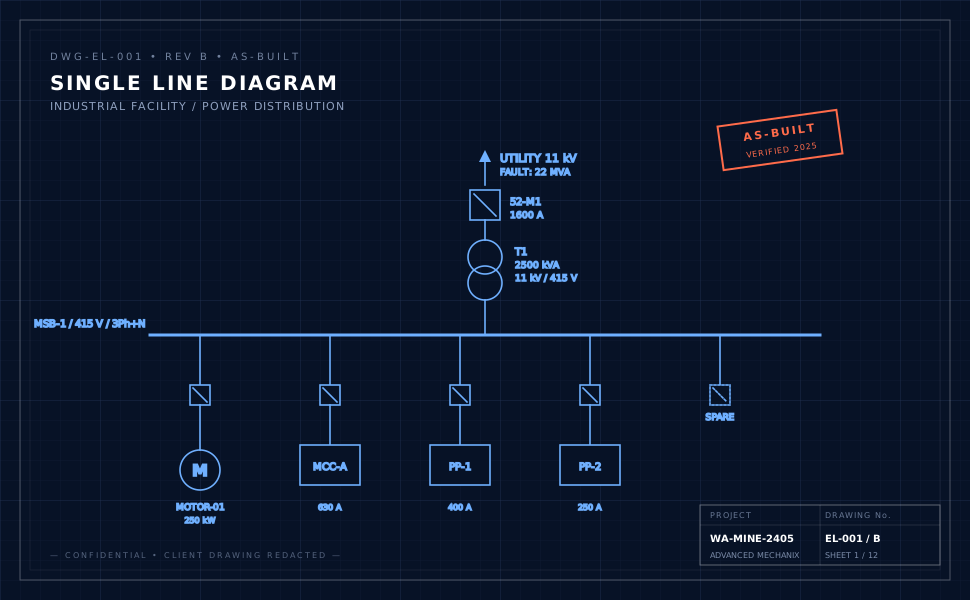
Arc flash study deliverables

SLD Verification
Field-verified single-line diagram updated against actual installed equipment, breaker settings, and recent modifications.

Short-Circuit Analysis
Three-phase and single-phase fault calculations at every bus per IEEE / IEC methodology.
Protection Coordination
Time-current coordination study verifying selectivity and identifying mis-coordinated protection.

Incident-Energy Calculation
IEEE 1584 incident-energy at every relevant bus, including arc-flash boundary and approach-distance calculations.

NFPA 70E Labels
Print-ready ANSI Z535-compliant labels with incident energy, PPE category, and approach boundaries.
Mitigation Recommendations
Where incident energy exceeds Cat 2, we provide protection-setting and equipment-modification recommendations to reduce it.
Start with a defined scope.
Agree the source information, deliverables and review requirements before the first issue.
Your team. Our team.
A clear way to work.
Agree the standards, review responsibilities and working arrangements before the first issue.
Quality: who checks the drawings?
The checking brief covers the project standard, drawing references and review responsibilities. We agree the internal checks, client review sequence, revision allowance and response windows as part of the package scope.
Standards: will you draw to our codes and templates?
We work to the standard that applies to your project: NEC (US), IEC 60364 and IEC 61439, AS/NZS 3000 (Australia and New Zealand), CSA C22.1 (Canada) and BS 7671 (UK). We draw inside your title blocks, layer conventions, cell and block libraries, not ours.
IP and NDA: what happens to our files?
Confidentiality and file access are agreed before source material is shared. Tell us if you require an NDA or a client-managed workspace, VDI or VPN. The scope identifies the permitted environment, access arrangements and handover requirements.
Stamps: who signs the drawings?
If your package requires a PE, Chartered Engineer or other statutory sign-off, tell us during scoping. We agree the responsible party and review requirements before production starts.
Time zones: when can we talk to the team?
Our production team is based in Pakistan (PKT, UTC+5). We agree your project’s working hours and handover arrangements during scoping. The table below uses a 09:00–18:00 PKT reference window to help plan the overlap; it is not a committed project schedule.
| Your time zone | Reference window, your clock | Overlap with your 09:00–17:00 |
|---|---|---|
| Perth — AWST (UTC+8) | 12:00–21:00 | 5 h (12:00–17:00) |
| Brisbane, Sydney — AEST (UTC+10) | 14:00–23:00 | 3 h (14:00–17:00) |
| Dubai — GST (UTC+4) | 08:00–17:00 | 8 h (09:00–17:00) |
| London — GMT (UTC+0) | 04:00–13:00 | 4 h (09:00–13:00) |
| New York — ET (EST, UTC−5) | 23:00–08:00 (overnight) | None — overnight handover |
| Los Angeles — PT (PST, UTC−8) | 20:00–05:00 (overnight) | None — overnight handover |
Daylight saving: Sydney, Melbourne, Canberra and Hobart move to AEDT (UTC+11) from October to April, cutting the overlap to 2 h (15:00–17:00); Queensland and Western Australia stay on standard time. UK summer time (BST, UTC+1) widens the London overlap to 5 h (09:00–14:00). US daylight time moves our day to 00:00–09:00 EDT and 21:00–06:00 PDT, so US teams can plan an overnight handover; the actual arrangement is agreed for your project.
Arc flash study questions
What does an arc flash study include?
What software do you use?
How long does an arc flash study take?
Do you provide the equipment labels?
Do you handle the data collection?
How often do studies need updating?
Five years since your last arc flash study?
Tell us the source information, drawing types and target issue date. We agree the deliverables, review allowance and price before work starts.
Reference sources
Use the project’s nominated standard and edition for the work. These publisher pages provide context; this guide does not replace the applicable standard or engineering review.