TL;DR
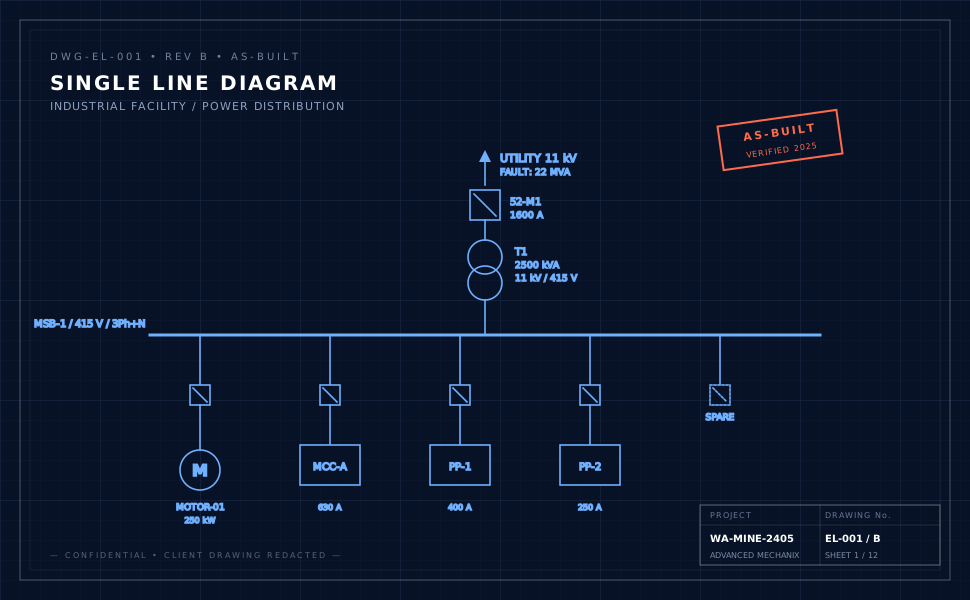
A single-line diagram is a simplified electrical schematic that represents a three-phase power system as a single line, showing sources, transformers, protective devices, and loads — plus their ratings and how they connect. It's the master document of any electrical system.
The short answer
A single-line diagram — often shortened to SLD, sometimes written "one-line" in North America — is a drawing that represents a three-phase electrical distribution system as if it had only one wire instead of three. It's the most frequently referenced document in any electrical project: designers use it to plan, commissioning engineers use it to test, and maintenance teams use it to troubleshoot twenty years later.
Why "single-line"?
Nearly all industrial and commercial power distribution is three-phase. A literal schematic would show three lines between every component, with neutral and earth on top. By the time you've drawn a medium-sized facility, the page is unreadable.
The single-line convention agrees to draw only one line per circuit path. Phase information, where it matters, is indicated in notes or secondary notation (3Ph+N, L1-L2-L3, etc.). The trade-off: simplicity wins, at the cost of explicit per-phase detail. For per-phase detail, engineers use three-line diagrams or schematic drawings.
What a single-line diagram shows
At minimum, a complete SLD shows:
- Sources — utility feeds, generators, renewable inputs, with ratings (voltage, fault level, phase count)
- Transformation — transformers with their ratings and voltage ratios (e.g. 11 kV / 415 V, 2500 kVA)
- Protection — circuit breakers, fuses, protection relays with ratings and ANSI/IEC device numbers
- Distribution — buses, main switchboards, sub-boards, MCCs with their voltage and current ratings
- Feeders — cables and cable ratings between components
- Loads — motors, variable-frequency drives, lighting panels, large single loads, typically with kW rating
- Grounding — earth reference, neutral-to-ground, grounding transformer if present
- Metering & instrumentation — current transformers, voltage transformers, meters
Standard symbols
Single-line diagram symbols are standardized, but which standard depends on jurisdiction:
| Region | Primary standard |
|---|---|
| United States | IEEE Std 315 / ANSI Y32.2 |
| International | IEC 60617 |
| Australia / NZ | AS/NZS 1102 |
| United Kingdom | BS EN 60617 (IEC aligned) |
Most symbols are immediately recognizable across standards (a transformer is always two circles), but device detail notation — breaker close/open, disconnect symbols, protection relay numbering — varies. Always verify which standard the drawing set references in the title block.
How to read one
Read top-to-bottom, following power flow:
- Find the source at the top — utility or generator, with its voltage and fault level.
- Trace downward through main disconnect / breaker to transformer (if present).
- Transformer secondary feeds the main bus — usually the widest horizontal line, labeled with voltage and current rating.
- Vertical lines drop from the bus to downstream distribution equipment: sub-boards, MCCs, motor starters, large loads.
- Each branch will have its own breaker or protective device at the bus tap.
- Read notes and title block for protection philosophy, coordination references, and revisions.
When do you need one?
Essentially always, for any system larger than a residential subpanel:
- Design phase — to scope equipment, size conductors, specify protection.
- Construction — as the as-built reference for installation teams.
- Commissioning — to verify installed system matches designed system.
- Maintenance & operations — for troubleshooting, isolation planning, shutdown scheduling.
- Arc flash studies — the SLD is a required input to IEEE 1584 / NFPA 70E analyses.
- Protection coordination — the SLD is the baseline for relay setting studies.
- Regulatory compliance — required by NEC, AS/NZS, IEC, and utility interconnection processes.
Common mistakes
- Missing ratings. Every component should have its voltage, current, and fault rating. SLDs that omit this are effectively useless for maintenance or protection coordination.
- Outdated revisions. Field modifications not reflected on the drawing are a safety hazard. The SLD should be kept current as an "as-operated" document, not just a project-delivery artifact.
- Inconsistent symbology. Using a mix of IEEE and IEC symbols within the same drawing set confuses readers and fails jurisdiction review.
- No fault-level information. Fault levels at every major bus should be noted. Without this, downstream equipment can't be properly specified or maintained.
How we produce single-line diagrams
Advanced Mechanix produces SLDs daily for industrial, mining, commercial, and utility clients. Every drawing is delivered against the applicable jurisdiction's code (NEC 2023, IEC 60364, AS/NZS 3000, CSA, or BS 7671), inside the client's own template and cell library, with multi-stage QA before issue.
Turnaround for a standard SLD is 3–5 business days from kickoff. Complex multi-sheet packages (MCC schedules, protection coordination) run 2–3 weeks. First drawing is free for new clients.
Drawing
Free
Need an SLD delivered this week?
Send us your source material — single-line on existing equipment, a new design brief, or a legacy drawing that needs updating. First drawing free, regardless of complexity.
We can afford this because SLDs are routine production work. One drawing costs us almost nothing.